How to Solve Word Scrambles Fast — A Practitioner's Guide
If you searched "how to solve word scrambles fast" and ended up here, you've probably noticed something weird about the results. The top hit is usually a 4-year-old Reddit thread. The next one's an SMS marketing site that has nothing to do with word games. Then there's a 16-year-old StackOverflow question about an algorithm written by someone who clearly wasn't trying to play the game — they were trying to solve it with code.
Trust us, we know. We looked too.
We make daily word games and other puzzles for a living, so we've watched thousands of players get faster at this. Good news: getting fast at word scrambles isn't a talent thing. It's a pattern-recognition thing, and patterns can be learned in about a week of paying attention.
This guide is the stuff we'd tell a friend who asked.
Why Most Word Scramble Advice Is Bad
The reason most word scramble advice is weak isn't that nobody's good at word scrambles. Most fast players solve a 7-letter word scramble in under 30 seconds. Beginners take 90 seconds or more. The gap closes faster than you'd think.
Most "tips" articles you'll find were written by content marketers who Googled "word scramble tips," skimmed three other articles that did the same thing and rearranged the bullet points. So you get the same six pieces of advice ("look for prefixes!" "use a pencil!") repeated forever, with no sense of what actually moves the needle when you're sitting there staring at seven letters and the clock is running.
The reality is more specific. There's a small set of mental shifts that take a beginner to an intermediate player in a week or two. We'll walk through them. None of this is rocket science. It's just stuff most articles skip because they don't actually play.
Quick disclaimer: this guide is geared toward 6 and 7-letter scrambles, the format we run at Wordga and the most common format in modern daily word games. Most of what's here also works for longer scrambles, anagram puzzles and Scrabble® racks — but that has its own scoring math we won't get into, though we do have Scrabble-related content you can learn a lot from.
Stop Reading & Start Scanning

Here's the single biggest unlock, and it sounds dumb until you try it: most beginners try to read the letters as if a word is hiding in them.
You stare at C-A-R-I-N-T-E and your brain tries to assemble it from left to right, rotating letters like a tiny mental Tetris game. Sometimes a word pops out. Most of the time, it doesn't, and you're stuck.
Faster players don't do that. They don't try to see a word. They scan for parts of words — pairs of letters, common endings, common starts. They're not thinking, "What word is in here?" They're thinking, "What familiar chunks are in here?" Once you spot the chunks, the words assemble themselves.
The shift takes about a week of conscious practice to lock in. Once it does, you stop "trying to find words" and start "spotting building blocks." Remember, pattern recognition is a primary skill here.
The 5 Letter Patterns Every Word Scramble Hides

These are the chunks. Memorize them. They show up in roughly 80% of the scrambled words you'll encounter, and they're the first thing your eye should hunt for when a fresh word scramble loads.
1. Common consonant pairs
TH, CH, SH, PH, WH, ST, SP, TR, BR, CR, DR, FR, GR and PR. If you see a T and an H in the letter set, that's a pair worth checking.
- T-H-I-N-K
- T-H-O-S-E
- T-H-E-R-E
Notice how often "TH" anchors the word.
2. Common 3-letter endings
-ING, -ED, -ER, -ION, -OUS, -EST, -LY, -EN and -AL. Suffixes are easy free wins. The single most underrated trick in word scrambles is checking for an -ING ending. If you have an I, an N and a G, you've already accounted for three letters of any verb in the puzzle. The rest often forms an obvious base. -ING shows up in roughly 1 in 8 English words. -ED in 1 in 12. Train your eye to spot these endings and you've effectively pre-solved a third of any word scramble.
Try it: with N, G, I, R, A, S and T, you'd see -ING and almost immediately spot RATING, STRING and RASING.
3. Common starts
UN-, RE-, DIS-, IN-, OVER-, MIS- and PRE-. These are prefixes, and prefixes are gifts. If you spot a U and an N together, ask yourself, "What's the rest of the word if these two are tied up at the front?" UNDOING, UNREAL, UNTIE.
4. Vowel rules
Every English word has at least one vowel (Y counts when it has to). When you load a scramble, mentally separate the vowels from the consonants before doing anything else. A 7-letter set with three vowels has way more long-word potential than the same length with one. If you've got one vowel, you're looking for short words and probably one big word built around that vowel.
5. Q-U pairing
If there's a Q, there's almost always a U next to it. Don't waste mental cycles trying to use the Q without its U. Lock them together as a unit and treat them as a single tile.
Visual anchor
Most fast players hold these patterns in their head, not as a list but as a cheat sheet they can scan against. Print or save the image of the list, look at it for a minute before your next puzzle and watch how differently your eyes move across the letters.
Vowel-Consonant Counting for Word Scrambles
Before you try to solve anything, scan and count.
How many vowels? How many consonants? What's the ratio?
This tells you what kind of puzzle you're in. The rough heuristic or mental shortcut:
- Three vowels in a 7-letter word scramble. Lots of options. Several 6-7 letter words are likely available. Don't settle for the first 5-letter word you see.
- Two vowels in a 7-letter word scramble. Tighter. Usually one or two long words and a handful of short ones. Look for words built around a strong consonant cluster.
- One vowel in a 7-letter word scramble. Hardest. The long word almost always uses every consonant around that single vowel. Think LYNCHED, STRENGTH, CRYPTS.
- Four or more vowels in a 7-letter word scramble. Rare. Often signals an unusual word — AUREATE, OUTLINE or AUDIO-something. Don't be thrown off by it.
Counting takes two to three seconds and reframes the whole puzzle. You stop looking for "any word" and start looking for the right shape of word.
A drill for this: load a scramble, do the count out loud before you try to solve it, predict how many long words are available, then play it out and see if you were right. After 10 of these, your intuition for vowel density becomes ingrained.
The "Branch From Short Words" Technique
Most beginners hunt for the longest word first. They want the big score. They stare at the puzzle hoping a 7-letter word will reveal itself, find nothing for 30 seconds and move on frustrated.
Faster players do the opposite. They find the easiest word first — usually a 3 or 4-letter word — then extend or grow it.
Say you spot RAIN in a 7-letter scramble. Before moving on, ask: what's RAIN plus one of the remaining letters? RAINS? RAINY? BRAIN? TRAIN? GRAIN? Now what's that 5-letter word plus one more? BRAINS, BRAINY, TRAINS and GRAINS. Now plus one more for the 7-letter? BRAINSY isn't a word but BRAINING is, and so is GRAINING.
We call this "branching". You use the easy word as scaffolding and climb to the harder one. It works because you're constraining the problem. Instead of asking, "What 7-letter word lives in here?" you're asking, "What letters turn BRAIN into a longer word?" That's a much smaller search space.
It also works in reverse. If you've found a 6-letter word, ask whether dropping any letter and adding another from the unused pile makes a different word. Lots of bonus words hide in this kind of one-swap territory.
Common 7-Letter Word Skeletons
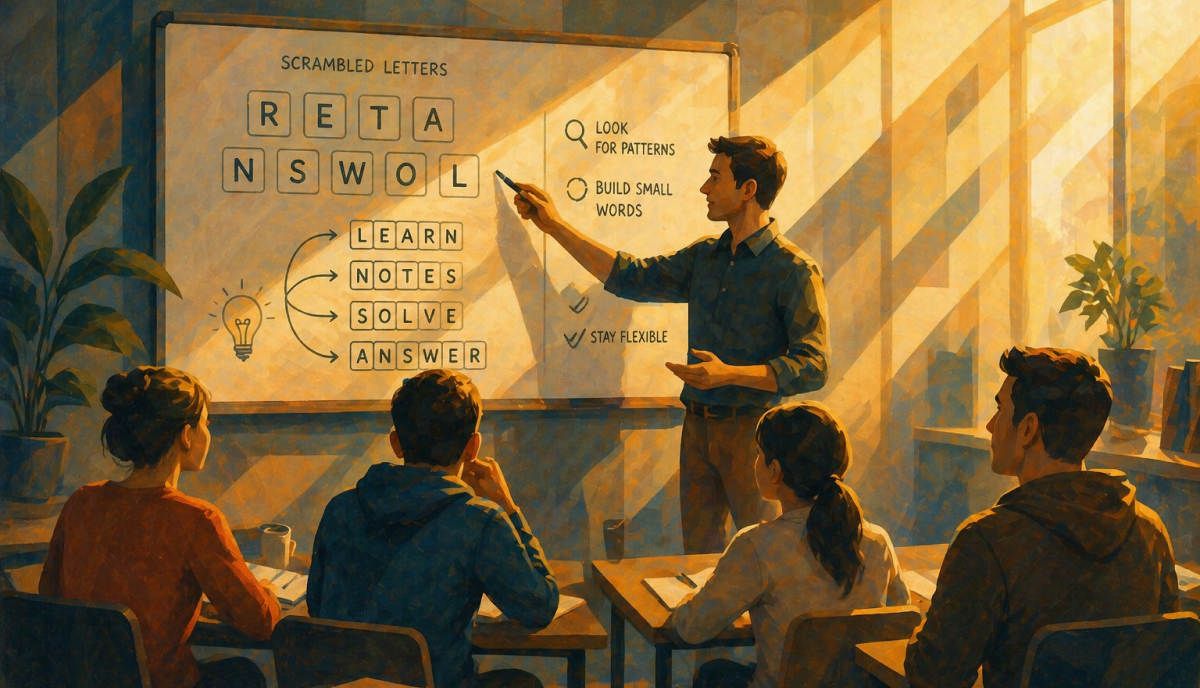
After enough scrambled words, you start to notice the same word shapes show up over and over. These are the skeletons — the architecture behind most meaningful words that anchor 7-letter scrambles. Knowing them gives you a head start on any word scramble that contains the right letters.
-ATION endings
STATION, NATION and RATION. If you have A, T, I, O and N in the same set, this ending is almost guaranteed to be in play.
-EARING endings
BEARING, HEARING, TEARING and WEARING. The E-A-R-I-N-G chunk is six letters; you only need one consonant to anchor it.
-OUS endings
Less common but punchy: NERVOUS, FAMOUS and RIOTOUS. The -OUS pattern by itself is a fast 3-letter unlock.
-IGHT endings
LIGHT, NIGHT, RIGHT, BRIGHT and PLIGHT. The I-G-H-T cluster is one of those shapes that's hard to see if you're scanning letter by letter and obvious if you're scanning in chunks.
You don't need to memorize an exhaustive list. You need to know that these skeletons exist so your brain stops inventing words from scratch and starts pattern-matching against shapes it already knows.
The 10-Second Trick: Rearrange as Needed
A lot of older articles tell you to physically rearrange the letters — write them down, scramble them with a pencil, draw lines. That advice is from a different era. In 2026, the puzzles are on a phone, the timer is running and manual rearranging is too slow. Most modern word scramble games have a built-in shuffle, and this is very useful when looking for the shapes you remember.
But what if you're playing a written word scramble? Here's a practice that works for both digital and physical versions:
Pick any seven letters. In your head, read them in alphabetical order. Then, in reverse alphabetical order. Then group all the vowels together, then all the consonants. Then read the consonants in clusters of two.
Sounds like a parlor trick. It's not — it builds a real skill. Word scrambles don't have a "correct" reading order; the letters could be a word in any order. The faster you can mentally re-sort them, the more candidate words your brain considers per second.
A drill: grab a Scrabble bag or any letter set. Pull seven random tiles. Without writing anything down, recite them in alphabetical order, then group the vowels first, then group by frequency. Do this for five minutes a day for a week. After a week you'll notice the difference yourself — your eyes won't get stuck on the original letter order anymore.
When to Give Up on a Word
This is the one nobody talks about, and it might be the most important.
If you've stared at the same letter sequence for 10 seconds and nothing's coming, move on. Don't get trapped in a loop. Lock it in your head as "I'll come back to this." Find a different word. Find any other word.
Finding word B clears whatever pattern your brain was stuck on for word A — that burst of accomplishment and confidence removes mental blocks and helps rewire your brain. You come back 30 seconds later and word A is suddenly obvious. The subconscious is doing real work in the background. You just need to stop blocking it with active stare-thinking.
The sunk-cost mistake is the killer, or in layman's terms, "I've already put so much time into this, I'll get it a few more seconds!" kind of mentality. Players will spend 45 seconds chasing a word they've half-glimpsed when they could have found three other words in that time. Don't. Mark it, move on, return.
A specific rule of thumb we use: 10 seconds of nothing means switch or shuffle. If you haven't gotten a foothold on a word after 10 seconds, your current frame on the letters isn't working. Reset by finding any other word or shuffling, then come back fresh.
Speed vs. Completeness — Two Different Games
Most word scramble games come in two flavors, and the strategy is genuinely different for each.
| Speed mode (Daily Blitz) | Completion mode (Daily Run) | |
|---|---|---|
| Time pressure | 60 seconds × 3 rounds | None — find them all |
| Optimal strategy | Volume over length | Methodical branching |
| What to find first | Easy 4-letter words | Anchor word, then extend |
| Common mistake | Chasing the 7-letter and burning the clock | Stopping at the obvious words |
| Mental mode | Pattern-spot, submit, repeat | Slow scan, layer by layer |
Speed mode (timed, score-per-word)
Wordga's Daily Blitz is this — three rounds of 60 seconds, points for every word found. Here, completeness is a trap. The optimal play is to fill the time with as many short words as you can, then chase one or two long ones if there's time left. Don't burn 20 seconds hunting a 7-letter word when you could've banked four 4-letter words instead.
Also, if you're playing Wordga, don't forget that you can use your keyboard to cut big chunks off your time. No need to drag the letters everytime.
Completion mode (untimed, find them all)
Wordga's Daily Run is this — no clock, but you're trying to find every valid word in the set. Here, completeness is the whole point. The branching technique becomes much more valuable because you're not racing the clock; you're systematically exploring the letter space. Slow, methodical, layered.
Knowing which mode you're in changes the strategy entirely. Beginners often play completion-mode strategy in a speed game and bomb the clock. Or they play speed strategy in a completion game and miss half the words. Pick the strategy to match the format.
How to Practice (a Real, Small Daily Routine)
You don't need to grind for hours. The honest answer: 5 to 10 minutes a day, every day, beats an hour once a week by a wide margin. Pattern recognition compounds with reps, not with time per session.
A practice routine that actually works:
- Days 1-3. One round of any 7-letter scramble per day. After each round, write down two patterns you noticed. Don't try to be fast. Just notice.
- Days 4-7. Two rounds per day. Now try the vowel-consonant pre-scan before each one. Predict the puzzle's difficulty before solving. Track whether you were right.
- Week 2. Three rounds per day. Add the branching technique — start every solve from the shortest word you see and grow up.
- Week 3. Add a timed round. Same scrambles, but now 30 or 60 seconds. The pressure surfaces that patterns you've actually internalized and which you're still hunting for consciously.
- Week 4 onward. One untimed completionist round and one timed speed round per day. This trains both modes.
For the actual practice scrambles, you have options. Wordga Unlimited gives you a fresh 7-letter word scramble every time you load the page — no signup, no daily limit, just clean random letters and an unlimited supply of word scramble games to drill on. We built it because we wanted a practice tool ourselves. Any other anagram generator or word scramble maker works too; the format matters more than the source.
Common Mistakes That Slow People Down
A short list of the patterns we see eat the most time in player sessions. Recognize any of these in your own play and you'll get a noticeable speed boost.
👉 Hunting the longest word first. Already covered, but it's the top mistake. Find the easy ones first; the long ones reveal themselves as scaffolding accumulates.
👉 Ignoring 4-letter words and going straight for 6-7. 4-letter words are points in speed mode and stepping stones in completion mode. Either way, they're worth grabbing. Skipping them is leaving free score on the table.
👉 Re-reading the same letter order over and over. If you've read the letters left-to-right three times and nothing's coming, that's a signal. Reset visually. Re-shuffle the letters. Group vowels together, consonants together. Force a different read order.
👉 Not separating vowels visually. Most digital word scrambles let you tap or drag letters into different positions. Use it. Pull all the vowels to one side as the first move on every puzzle. The shape changes, and so does what your brain notices.
👉 Trying to verify a word before submitting. In speed mode, submit and find out. The penalty for a wrong word is usually losing a couple of seconds; the penalty for hesitation is losing a real word you would have gotten next. Life's a better with a little risk, send it.
👉 Solving while distracted. Word scrambles are short attention bursts. If you're playing while half-watching TV, your speed will be roughly half what it could be. Even 60 seconds of full focus beats five minutes of distracted play.
FAQ
What's the fastest way to solve seven-letter word scrambles?
Pre-scan vowels vs. consonants, find a 4-letter word first, then branch upward by adding letters one at a time. The mental sequence matters more than any single trick. Most fast players solve 7-letter scrambles in under 30 seconds once they've locked in the pattern recognition.
Do top word-scramble players use a system or is it intuition?
Both, but the intuition is built on system. Every fast player you watch is doing the chunk-recognition unconsciously, but they got there by drilling the patterns deliberately. The system becomes invisible because it's automatic. If someone tells you they "just see it," what they mean is they did the work long enough that they no longer notice they're doing it.
Are word scramble solvers cheating?
Yes for actual play, no for learning. A word scramble solver during a live game — especially a daily streak game — is you cheating yourself out of the practice that makes you faster. Using a word scramble solver after a round to see what you missed, and to learn the patterns of the meaningful words you didn't find? That's training. Same as a chess player reviewing a game with an engine.
The honest take: word scramble solvers are training wheels. Useful for the first week, terrible if you're still on them in month three. Use a solver to study, never to play. The brain doesn't build pattern recognition by reading answers — it builds it by struggling and finding.
How long does it take to get good at word scrambles?
Two to four weeks of daily 5-to-10-minute practice gets a beginner to "comfortable intermediate" — meaning you'll consistently find most of the medium-length words and at least one long one in a typical 7-letter set. Real expertise — top 5% leaderboard speed — takes six months or more of regular play, plus deliberate pattern study.
What's a typical solve time for a 7-letter scramble?
Beginners: 60-120 seconds to find one or two words. Intermediate: 30-60 seconds to find most words. Advanced: under 30 seconds to find the full set. Top players can clear a 7-letter set in 10-15 seconds when the patterns line up cleanly.
Are there tricks to find hidden words faster?
The biggest one is the branching technique — find a small word, grow it. The second biggest is committing the common endings (-ING, -ED, -ION, -OUS) to muscle memory so you spot them instantly. Most "hidden" words aren't actually hidden; they're built around a familiar chunk you didn't scan for.
Is it better to play one big puzzle a day or several small ones?
Several small ones, if you're trying to improve. Pattern recognition strengthens with reps, not with marathon sessions. Five short scrambles spread across a day will beat one long session at the kitchen table. Treat it like flashcards, not like homework.
Do word scramble skills transfer to other word games?
Mostly yes. The letter-pattern recognition transfers cleanly to Scrabble, Boggle, Words With Friends and most anagram-based games. It transfers partially to crosswords (which lean more on vocabulary breadth and trivia knowledge) and barely at all to Wordle-type games (which is about deduction more than anagram skill). If you get fast at scrambles, expect to gain a step in any anagram-format game.
What's the best way to play word scramble games online for free?
Wordga gives you three free modes with no signup. Daily Run is one fresh 7-letter word scramble per day, untimed, find them all. Daily Blitz is three 60-second rounds for speed practice. Wordga Unlimited gives fresh random letters every page load when you want to drill patterns without limits. Other places to play word scramble games include Outspell, Anagram Magic and most classic puzzle apps — each has its own flavor, but the pattern-recognition skill transfers across all of them.
Play Word Scramble Games Today!
We hope that we were able to help you learn how to speed solve 7-letter anagrams. You've spent the last 10 minutes reading about how to do this. The patterns won't lock in from reading. They lock in from solving.
Wordga Unlimited gives you a fresh 7-letter scramble every time you load the page. No signup, no clock, no streak pressure — just a practice surface to drill the patterns we walked through. Vowel pre-scan first. Find a short word. Branch up. Move on when you're stuck. Come back when you're not.
If you want the daily version with a leaderboard and the speed/completion split modes, that's the regular Wordga puzzle. But for sheer practice volume, Unlimited is the tool we use ourselves.
 Mini Crossword
 Midi Crossword
 Diffle
 Killer Sudoku
 Numberle